Sunday, August 21, 2016

Sushi Cake

Updated July 4, 2019 with new pictures (at the end).

When D4S1 was turning 7, I asked him what kind of cake he wanted for his birthday. I've made all their birthday cakes myself (except that one year that my best friend was in town and did it for me), because we found out when he was nine months old that he reacted to wheat. So I needed to know... chocolate? Vanilla? Carrot? Peanut Butter and Jelly? I didn't give him a prepopulated drop-down list, I figured he knew what the choices were.

His response was, "I wish there was a way to have a sushi cake."

That was not in the universe of things I thought he might say.

I asked for more information. "Do you mean a cake that looks like sushi, or a cake made of sushi?"

"A cake made of sushi!" he responded with enthusiasm.

"You know, I think I  could do that."

And so I did. I pressed a layer of rice into a springform pan, then added a layer of fillings, and kept doing that. And it worked!

Every year since, we've done the same thing. I've gotten pretty good at it. This year, R8S2 asked for one for his 8th birthday.

For the Cultural Potluck at the end of this past school year, D4S1 said he wanted to bring sushi. I reminded him that we are in no part Japanese. This did not dissuade him. I decided that, given its relevance to our family's particular culture, sushi cake was an acceptable contribution. While I completely failed to get pictures of them, I made two smaller cakes... one with fish and one vegan. I figured that sixth graders would be shy about consuming raw fish. I was wrong; that one reportedly disappeared in short order, while there were leftovers of the vegan one. Lesson learned.

I've now made nine different sushi cakes in all. It takes me about 45 minutes to do the actual assembly and decoration, but there's some prep work with making the rice and slicing the fillings. 

People ask how I do it. It's not terribly hard, though having the right equipment helps. Here's the rundown...

What you'll need:
Sushi rice (regular short-grain rice can work too, but sushi rice is finished slightly differently)
Rice vinegar
Sugar
Sea salt
Sushi fillings (vegetables, fish, whatever you desire)
Seaweed for decorating (optional)
Large bowl, preferably wooden
Rice paddle or other similar implement
Springform pan (I have never tried doing this in a regular cake pan. I really don't know if it would come out.)
Wax paper

What to do:

Make Sushi Rice

   4 cups Sushi Rice (uncooked)
   water sufficient to cook

Cook sushi rice per instructions. If you have a rice maker with a sushi rice setting, that works great. If it's a Zojirushi, that's 6 of the little cups that came with it (which are 2/3rds of an American cup).

Mix together:
   1/2 cup Rice Vinegar
   3/8 cup sugar (6 tablespoons)
   2 tsp. sea salt

until the sugar and salt are dissolved.

Dump the rice into a large bowl (a wooden salad bowl is great for this), and pour over the vinegar/sugar/salt mixture. Mix with a rice paddle or large spoon until thoroughly integrated.

While that cools a bit, chop up your fillings of choice. Our favorites are cucumber; avocado; sashimi-grade salmon,  yellowtail, and tuna; salmon roe; and shrimp (butterflied). If you choose to use raw fish, make sure you are using a source that is intended to be consumed raw. Use anything you like in sushi... crab meat, cream cheese, tamago, tofu... it's all good. (By the way, the shrimp come already cooked and butterflied that way in a frozen package from the market where I get all my sushi-specific stuff. I have no idea how to make them look like that.)


Take a 9" springform pan and cut a circle of wax paper that fits pretty well in the bottom.


Using a rice paddle or something similar (maybe a rubber spatula or something? I haven't tried other tools), press a thin layer of sushi rice into the bottom of the pan. I used to use my hands for this (get them wet first, so the rice doesn't stick to them!) but the paddle gets a tighter layer. Press it allll the way to the edges-- you want the edges really tight so your cake looks smooth and round (and doesn't fall apart) when you take it out of the pan. The layer shouldn't be more than a quarter-inch thick-- the thinnest you can do without being able to see the wax paper through it.


Add your ingredients in a radial pattern. This is something I've refined over the years-- at first I'd just line them up across the pan, but that makes the cake harder to cut. So I started arranging them in a radial pattern and that works much better.


More recently I've used even smaller pieces:


Now, repeat until you've filled the pan:


Next, turn it over onto your chosen cake platter:

I have another piece of wax paper here as sort of a doily for the base. I'm not good at making doilies out of wax paper. See, sushi cake does not require any great general artistry or craftiness.


Next remove the sides of the springform pan:

 And then the bottom:

This was when I was still figuring out how to line the pan. Now that I use the wax paper, it comes out like this:


Next you decorate. This is really just a matter of arranging things in an artful pattern on top. But this year, I actually cut letters and numbers out of seaweed to put D4S1's name on it:


The Sushi Cake has developed quite a bit over the years. My first year, this is what it looked like:

 I tried lining the entire pan with seaweed. It made sense in my head. It doesn't work that well.

For his 8th birthday, I used rice molds to try to make it cuter:
...but the seaweed REALLY doesn't work well on the inside of the pan. It just kinda melts.

I started to get that by year three:

That was, you'll never guess, his 9th birthday. After that, he said, "Mommy, will you please put the salmon roe inside the cake too?"


...but they're still fun to decorate with some.

By the fifth time, I was starting to get the hang of it:

And then this year is when R8S2 asked for his own:


2017:

2018 (birthday boy included):


2019:


And there's a detail of a slice.

Still finding ebi (shrimp) and ikura (salmon roe) to be the go-tos for decoration, but this year I found a small biscuit cutter that let me cut the cucumber slices into prettier shapes.

Saturday, September 05, 2015

Un(der)employment

An unemployed cat posted on social media that the unemployment rate has fallen to 5.1%, showing strong recovery.

A commenter noted:

"Most unemployed lost benefits long ago and are no longer counted among the statistics or percentages. Makes 'unemployment' look great when in reality it's not."

That is an oft-repeated point, and so I found myself curious about it. I looked at the labor force participation rate over time on BLS.gov (it's impossible to find by navigating the site, and there's no direct link, but if you google labor force participation over time you get right to it).


The graph at the left shows the rate from 1960 to now. The first mark on the Y axis is 60%; the top of the scale (which we never quite reached) is 67.5%.

Overall, participation went up steadily (with a few bobbles) from around 1970 to 1990. This is the period when women were entering the workforce in larger numbers (or just refusing to leave when they got married/had kids). It peaks, but only gently, around the dot-com bubble, and starts sliding downward right about 2008, when the bottom fell out of the market. 


So yes, labor force participation has dropped off since the crash, and in a steady way that certainly looks like people basically "aging out" of the tally.

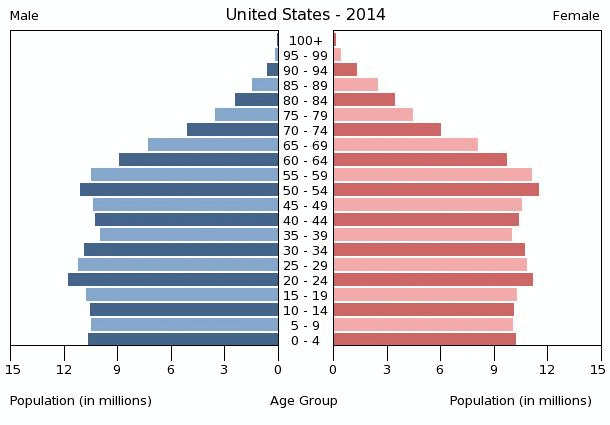
But there's one further factor to consider: the population pyramid.


  The bulge of the Baby Boomers has just started to cross the 65 threshold. How much of that drop-off are long-term unemployed, and how much are people who figured this is a decent time to get out anyway, since they're retirement age?

There's also the impact of the ACA. That will be more visible in the coming years, but certainly, with the ability to buy HMO and PPO coverage individually off of health insurance marketplaces for comparable prices to group employer insurance, regardless of existing conditions, some people who only held jobs so they were eligible for insurance have and will continue to leave the force. Leading up to HIE implementation, the CBO estimated that would be about two million full-time equivalents (where one person working full time is one FTE, and two people each working 20 hours a week is also one FTE).

What absolutely none of this addresses, however, is underemployment. I think it likely that the biggest issue isn't people who are no longer counted in the workforce, even though they need to support themselves or their families... but people who are scraping by on jobs that fail to make any reasonable use of their skills and education. Jobs that pay less than they used to, for the same work. People with Bachelor's degrees praying for a minimum-wage boost so they can get their car fixed, finally. To a large extent, the jobs we're regaining are simply the wrong jobs. I think it's this, more than anything else, that leaves people unsatisfied to hear "Unemployment drops to 5.1%." It just doesn't look that way from down here.

Wednesday, October 30, 2013

M/F/O

Posted on Facebook in reply to this link: Why Are Americans Terrified of Transgender 6-year-olds?
 
People are deeply unsettled by any ambiguity whatsoever around gender. Just take a look at some clips from the "It's Pat!" skits on Saturday Night Live poking fun at this human trait.

Try going into any toy store and saying "I need to get a birthday present for a two-year-old." They will immediately ask, before saying ANYTHING else, "Boy or girl?" They can't even BEGIN to process the request for help picking out a toy for a toddler until they have entered the correct gender category. For two-year-olds, who themselves don't yet have a fixed gender identity!

I remember in one of my Sociology classes learning about an experiment conducted in the viewing area at a maternity ward (back when babies all sat behind glass in the nursery). The researcher stood there admiring a particular baby. Another person or family would come along to gawk at their new relative, and he'd strike up a conversation. He'd ask who they were there to see, and say admiring things about their baby. They'd reciprocate, and he'd say, "That's my new niece over there." They'd then remark on those ballerina toes, or adorable cheeks, or beautiful curls. "What a delicate little angel!" they'd say.

They leave, next family comes in. Lather, rinse, repeat, only this time, "...nephew." Same baby. "Wow, look at him shake that fist! He'll be a tough one!" "He's built for football!" "What a little bruiser!" SAME DAMN BABY.

My own experiment: I've got two children. We didn't find out gender in advance for either of them. Cue fifteen random strangers a day asking "What are you having?" and not even knowing what to DO when I didn't know. My shower cake was half "It's a Boy" and half "It's a Girl" because the bakery literally didn't have any gender-neutral decorations.

We are nearly compulsive about reinforcing gender identity, as soon as possible, with everyone. We form our mental image of who a person is based on their gender first. It's no wonder that people who don't fit the assigned binary gender framework cause unease. We begin ALL social interaction with gender, and don't know how to proceed without it. That's what we need to change. People first.

Thursday, August 22, 2013

Not Me? Prove It.

Inspired by a screenshot from notallmenarelikethat.tumblr.com, which (apparently) showed  graphic online abuse based on gender, and (apparently) followed up with commentary that said, basically, "We cannot trust men to be allies, and feminism doesn't need them." I didn't read the original post; I've seen enough to get the idea. But I read the reactions of many people very upset at the notion that men would not be accepted as allies. And then I responded:

This reminds me of an experience I had in college. A Sociology professor who thought he was some hot s**t wrote on the board one day instructions that divided the class into different areas of the hall based on race. (Many people sat in the aisles because they didn't identify with just one race, but anyway.)

Then, we talked about race.

It was slow at first, but yes, it had the intended effect: with a homogenous group around you, it was easier to be honest and say the things you're usually afraid to say.

Then one African-American woman dropped a bombshell: "I expect all white people to be racist."

I'd noticed that she seemed generally not friendly, and definitely not interested in talking to me. Now it made sense, and I was offended.

She went on, though. "...because it's been my experience that they usually are, so if I just make that assumption up-front, I save myself a lot of heartache and hassle."

WHOA. That made me stop. Was I aware of pervasive casual racism? More or less, as a concept. It wasn't a part of my daily life, but yeah, I knew it was out there for some people. But I'd never stopped to think about what it would DO to a person.

"So yeah, they have to prove to me that they're NOT racist. And that's just the way it is." And now I know I have to prove it, and I can't expect someone who has lived a life of not-me white people belittling and dismissing and victimizing them to assume I'm any different.

But, dammit, I HAVEN'T had to live a life of people assuming I was uneducated, uncouth, and downright criminal from one glance at my face. So I decided right then and there I could put up with "proving it." It was a really, really small thing in the grand scheme.

So be an ally. But don't get bent out of shape that you have to prove it. Because yes, people have been hurt, sometimes really horrifically, by people "just like you" only not in ways we can't see. And they are simply learning from experience. Give them a different experience, but don't be shocked that they learned from what others taught them. That's just the way it is.

Monday, November 12, 2012

God bless the child that can pay his own way.


Mitt Romney, May 17, 2012: 
“There are 47 percent of the people who will vote for the president no matter what. All right, there are 47 percent who are with him, who are dependent upon government, who believe that they are victims, who believe that government has a responsibility to care for them, who believe that they are entitled to health care, to food, to housing, to you name it. That that's an entitlement. And the government should give it to them. And they will vote for this president no matter what. And I mean, the president starts off with 48, 49, 48—he starts off with a huge number. These are people who pay no income tax. Forty-seven percent of Americans pay no income tax. So our message of low taxes doesn't connect. And he'll be out there talking about tax cuts for the rich. I mean that's what they sell every four years. And so my job is not to worry about those people—I'll never convince them that they should take personal responsibility and care for their lives.”

Bill O'Reilly, November 6, 2012: 
“It’s a changing country, the demographics are changing. It’s not a traditional America anymore, and there are 50 percent of the voting public who want stuff. They want things. And who is going to give them things? President Obama.”

What I found most shocking about these two quotes... and most similar... is the lack of any sort of acknowledgment that people might actually deserve “stuff”. Might actually be “entitled.”

Is it possible that, if you work 60 hours a week, moving constantly, doing the things that other people don't want to do for themselves, stuff that requires lifting belts and work gloves, where you don't get paid vacations or sick days, that you have earned health care, food, and housing? Is that enough for Mitt Romney? Is it enough for Bill O'Reilly?

Here in California, the minimum wage is $8.00/hour. Plenty of really grueling jobs pay that wage. I'm not an accountant, and don't even do my own taxes... but I'll keep things simple. Here's the math for a family of four with one full-time, one part-time job at minimum wage:

60 hours per week x 52 weeks per year x $8.00/hour: $24,960 gross pay possible

...but let's say four days per year, on average, they're too sick to work. Because they're “contractors” instead of full-fledged employees, they don't get paid sick time (it's rampant all over the place... my mother-in-law has been a tech writer “on contract” for the last 13 years). So take off...

8 hours x 4 days x $8.00/hour: $256 so the gross is now $24,704. This assumes no vacation, no taking a morning off to go see their kid's holiday pageant at school, nothing.

But, these are still wages, so in spite of no paid vacation or sick time, they still pay payroll taxes. They're kind of complicated; there's several different ones. At least the $110,000 wage cap for social security deductions doesn't come into play. Here's what your hypothetical family will be paying:

FICA + Medicare: 7.65% of gross pay $24,704 = $1,889.86
Federal Unemployment Insurance: 0.9%* of the first $7,000 = $63
State Disability Insurance: 1.0% of gross pay $24,704 = $247.04
State Unemployment Insurance: 1.5% to 6.2% depending on employer's record; using average 3.85% of first $7,000 = $269.50
There's also an Employment and Training Tax, but it maxes out at $7 and isn't paid by all employers, so I'll just ignore it for now.

* Usually FUI is 0.6%, but California is paying its bills late, so we have to pay more into the Federal system.

The grand total of all wage taxes paid in a year by this family is now $2,469.40. But they haven't paid income taxes yet, so they're still in that 47%.

What do they have left at this point? $22,234.60 per year, for a family of four.

So do they pay income taxes? Well, let's take a look at the standard deductions, and the Child Tax Credit:

This family, assuming they're married, middle-aged, and not blind, qualifies for a standard deduction of $11,600, though there's the whole part about deducting the children and the tax credit. Some sources say such a family gets a total of $15,200 in deductions, which makes their taxable income $7,034.60.

According to the IRS tables for 2011, this family will owe $703 in Federal income taxes. However, since they have two children and make less than $110,000/year, they can claim $2,000 in child tax credits. These are now the tax-free folks who actually get money back from the government after a negative Federal tax bill. They can receive a credit of $1,297, to add to the $22,234.60 they take home.

We haven't even looked at what that $23,531.60 will pay for. This family has no health insurance, no 401(k) or IRA, and has to buy housing, food, transportation, clothing, and utilities. (But we're upset that they might get an Obamaphone.)

Why aren't they working more hours, though? Surely if they worked 80 hours a week, they'd be taxpaying citizens?

A family with two parents who work a total of 60 hours a week can get by without paying for childcare. Once you have two parents working full-time, though, you have to pay someone to care for the kids when they're not in school (if they're not under five and still not eligible for free education... another thing we don't think these people deserve). At minimum wage, the math just doesn't work out. Some families can rely on a grandparent or other relative for childcare, but if this person is not working, the wage-earning family likely is still somewhat responsible for the caregiver's expenses.

But let's say that their local school happens to offer some sort of free after school program, so they can both work 40 hours a week. Or one works 30 and the other works two jobs... somehow they get to 80 hours. They are still not paying taxes. With two children, you need a taxable income of $19,000 or more to exceed the tax credit, and the 80-hour a week minimum wage four-person family is at $14,634.92. Even if they get bumped up to $9/hour and 80 hours/week, they're in the 47%.

All they had to do was back-breaking, often humiliating, sometimes dangerous work, cleaning up after other people, 80 hours a week. And they think that this entitles them to health care, food, and housing? They think that they should have stuff?

In the Republican world, poverty is not just a moral failing. Your economic standing is a measure of your worth as a human being. If you do not already have something, that is sufficient to determine that you are not deserving of that thing. 

“Them that's got shall get, them that's not shall lose. So the Bible says, and it still is news.”

Saturday, November 10, 2012

The Invisible Hand is coming to get you!

The Invisible Hand works as well as it ever did... it was always a thought experiment. Adam Smith postulated that the Invisible Hand would act in a self-regulating market in the presence of three things: perfect information, perfect competition, and perfect mobility.

None of those are possible. However, labeling and fraud regulation bring us closer to perfect information. Anti-trust laws bring us closer to perfect competition. Perfect mobility is harder to accomplish through regulation, but the abolishment of Jim Crow laws, redlining, and other such practices that dictated where people could live and do business helped. More recently, the Internet (developed by the Defense Department and a public university) has done much to bring us closer to perfect mobility.

The Invisible Hand was never thought to prevent market fluctuations, though. In fact, Adam Smith and those who study him acknowledge freely that the efficient free market often *does not* address the needs of people. In a free market, those who can't perform will die. This is where the irrationality studied by behavioral economists comes in... we are social creatures, and so there is some "rational" behavior that gets overridden by our survival instincts. We know that if we always work against each other, we'll die. At first, only the weaker ones, but eventually, we will all die off because we fundamentally need each other.

Where the Invisible Hand seems to be failing, it is actually a failure of the very regulations intended to preserve it. Deregulation destroys a self-regulating market, by moving us further from perfect information (like information about what candidates the company donates money to), perfect competition (next I have to explain to the FCC why they shouldn't let AT&T buy T-Mobile), and perfect mobility (so long as we order on Amazon).

Monday, January 02, 2012

Talk is Cheap.

They say talk is cheap. They're right. There's no cheaper way to share information.

We went to the playground yesterday. D4S1* saw two people on the see-saw and said he wished he could teeter a totter. After noting that one of the people on it was a mom-looking person, I suggested he ask if he could join them, as he'd probably be successful. He did, and us parents followed R8S2 over to the track so he could ride his balance bike. We made visual contact every few minutes, but D4S1 is good at hollering if he doesn't think things are right, so he was pretty much on his own.

After a while, R8S2 asked to go play with his big brother. As we approached the zip line area, a woman who I belatedly figured out was the same one from the see saw came up to me and said "I just have to tell you how much fun my son is having playing with yours!" They'd been sticking together ever since the see saw, and having a ball.

We got to talking. I'll call her "Naomi." Her family was visiting from Springfield, Missouri, but she grew up in Orange County. She noted that she'd been homesick the whole last six years since they relocated, and they'd love to come back. We chatted about kids and their personalities, about home prices and their differences, and so on.

She asked about the Rose Parade... they were thinking of going. I couldn't help but share my fortune; I had two grandstand tickets, GREAT seats, and so D4S2 and I would be going. I was looking forward to seeing the Occupy the Rose Parade float.

Blank look. "You know... Occupy Wall Street? Occupy Los Angeles?" Shakes head.

"No... what is that?"

Now, I don't-- didn't, anyway-- consider myself completely disconnected from mainstream culture. Yeah, I make different choices; we don't have TV (we have a TV, which plays DVDs and console games), I don't read a newspaper... I get most of my news from links my friends post, and from my Google News Saved Search for things relevant to homelessness. But it really just floored me: there are still people who don't know that Zucotti Park on Wall Street in New York was occupied around the clock for nearly two full months; that the lawn around Los Angeles City Hall was similarly occupied for two months (starting and ending a couple of weeks later), and that similar protests have happened in cities across the nation.

So... I talked.

I knew little to nothing about this woman's political inclinations, history, background. I had no idea where here sympathies would lie, how her family earned money, what her gut reaction would be. I kept it simple, which is hard; it's complicated. I started with the what: thousands of people setting up camp in public places, in protest of corporate greed, the illegal actions taken by Wall Street firms that precipitated the financial crisis (with no charges filed), the people whose homes have been foreclosed illegally, the aggregation of wealth and political power with the 1%. I mentioned the pepper-sprayed UC Davis students (and even mimed the cop's casual stroll as he sprayed them), but didn't get into Scott Olsen.

Then I mentioned the evictions, the coordination services provided by the Department of Homeland Security, and the next phase, where some people are occupying foreclosed, bank-owned, vacant homes with families who have lost their homes in the financial crisis.

"Wow, I had no idea about any of that! I really need to start reading a newspaper."

And then I got to the really sad part: the newspaper probably wouldn't help much. Where mainstream media *does* cover Occupy, it tends to do so in a somewhat patronizing manner, focusing on things like littering or the homeless moving in, rather than the issues.

[Said in a perfectly reasonable, not at all self-righteous or dismissive, tone] "Well, maybe then these Occupy folks need to get better with the media..."

That's when I explained that they have a lot of people who are pretty good with media... but that there's no way to package this. I pointed out that it's leaderless; that you can't state in succinct, media-friendly soundbites what "the 99%" want. That it's a conglomeration of different ideas and goals and priorities. That it's about being heard, being represented; it's not about picking someone to be in charge and package the message. It's complex, and it has to stay that way, or it stops being what it is.

The boys stopped playing ball with a random family and got on the swings. As we pushed them (these swings are specially designed to be accessible; they're too big and heavy for the kids to swing themselves... which I suspect is why they like them so much), she asked me what I do, and I told her (grant writer for a homeless services agency). She asked me about feeding the homeless, and what I thought about whether it did any good (as a one-time thing). I told her I thought that, if done right, it could serve an important purpose in humanizing people who have felt dehumanized by their day-to-day experience. But on the other hand, hunger sometimes motivates people to connect to services, so isolating feeding people may prolong the time they spend on the street... so it could go either way.

As we headed back over toward the zip line behind our sons, I touched on NDAA and SOPA. She asked what I thought of Obama, and I told her. She confided that she finds herself consciously hiding her political beliefs; she fears what her community's reaction would be if they found out she voted for him. She mentioned religion in a positive light; I recommended The Christian Left, but she wondered what would happen if her neighbors saw she had "liked" it. I gave her some tips on double-talk for those situations ("Oh, I know, but they have some really good Christian messages...") and also mentioned that I have two Facebook accounts: one for work, and one for the rest of my life.

I was so uplifted by our conversation, the ability to share important information about the world with another person, the progress made in that hour... and dismayed by how isolated a person can be thanks to an intolerant community.

So I've decided: I need to talk more. I need to talk about what's going on. I don't need to lecture or advocate or evangelize... I just need to say "This is happening." Then people, like Naomi, at least have an opportunity to make up their own minds about it.

* For the sake of anonymity, I'm not using my children's actual names. I decided to give them codes, like they're Star Wars droids. The first letter is their first initial; the second is the last digit of their birth year; the third is their gender (S for son... it's the same for both, but would be D for any daughters I had in another universe) and the final digit is birth order.